An unusual idea, and a very old one
Most people expect medicine to work in a straightforward way. You get sick, you get treated. If you have asthma that gets worse in winter, you treat it in winter. That’s the logic we’re used to.
Chinese medicine has a different suggestion. It says that some conditions – the ones that come back every cold season, year after year – are best treated in the middle of summer. Specifically, on three particular days when the weather is at its hottest.
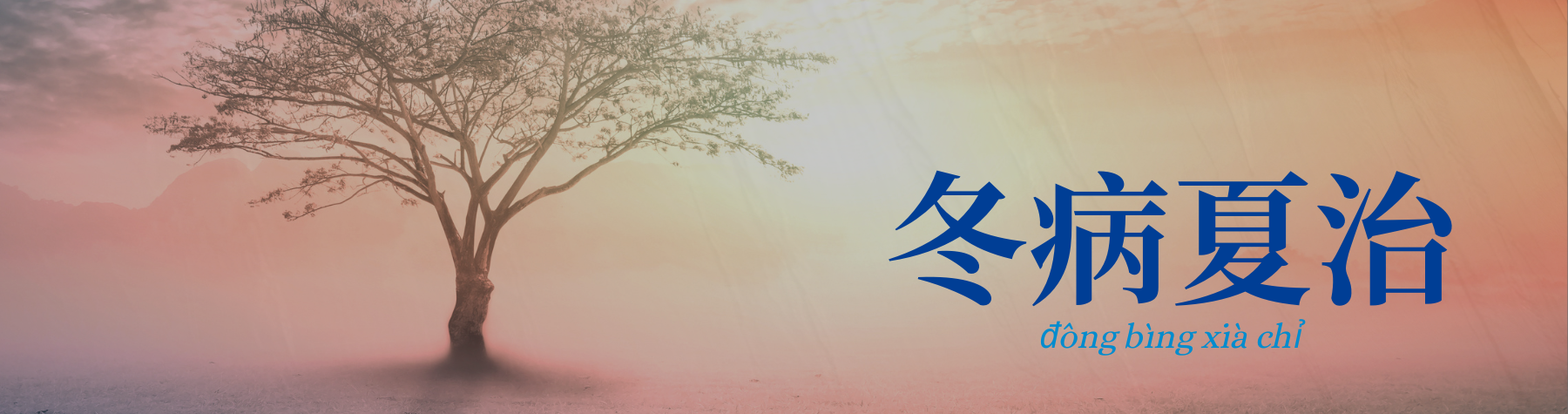
The idea has a name: dong bing xia zhi, which translates roughly as “treat winter disease in summer.” It’s been practiced in China, Korea, and Taiwan for hundreds of years, and there’s a specific therapy built around it. It’s called San Fu Tie — literally, “three fu patches.”
What actually happens
On each of the three treatment days, a small amount of an herbal paste is placed on a medical patch, and the patch is applied to specific points along your back and upper chest. You wear the patches for about two to four hours, then take them off.
The paste is made from a traditional blend of warming herbs. The most important is white mustard seed, which has been used for respiratory issues in Chinese medicine for centuries. The others are corydalis, asarum, and small amounts of a few more. They’re ground into a very fine powder, then mixed with fresh ginger juice — the ginger both binds the powder and deepens the warming effect.
While the patches are on, you’ll usually feel warmth in the area. Sometimes a bit of tingling. Occasionally the skin gets slightly red after the patches come off. All of this is expected. If anything feels genuinely uncomfortable, the patch comes off right away. That’s the treatment. It doesn’t require needles, and there’s nothing you swallow.
Why summer, specifically
This is the part that takes a little explaining, because it involves a way of thinking about the body that isn’t quite the one we grow up with.
Chinese medicine sees the body as something that changes with the seasons. In summer, more of your circulation is at the surface – this is why you sweat, why your skin feels warm to the touch, why cuts tend to heal faster. Pores are open, blood is closer to the skin, and, in the older language of the tradition, your yang energy is at its peak.
This has practical consequences for treatment. In winter, if you try to reach a deep-seated pattern like chronic asthma, the body is essentially closed for business. The circulation has pulled inward. Everything is guarded against cold. In summer, especially on the hottest days, the body is doing the opposite – it’s open, warm, and receptive. Warming herbs applied to the skin can actually reach the tissues underneath.
So the reasoning is: if the underlying pattern of your winter illness is still there in summer (which it usually is, even if you don’t feel it), summer is when you have the best chance of treating it.
The three specific days come from the Chinese lunar-solar calendar. They mark the beginning, middle, and end of the hottest period of the year. In 2026, they fall on:
- Tuesday, July 14 — Initial Fu
- Friday, July 24 — Middle Fu
- Thursday, August 13 — Last Fu
What San Fu Tie is used for
The treatment was developed with respiratory illness in mind, and that’s still what most people come in for. It’s often used for:
- Asthma, particularly the kind that flares in cold air
- Chronic bronchitis and lingering coughs
- Allergic rhinitis and sinus problems
- Frequent colds — the pattern of catching every bug that goes around
Over the centuries the indications have widened. Today it’s also used for people with cold hands and feet, chronic digestive issues that feel worse in winter, cold-type menstrual pain, and general low immunity. The common thread is a body that runs “cold” — one that struggles with cold weather more than it should.
Does it actually work? The honest answer
This is the question I get most often, and I think it deserves a careful answer.
There’s a long tradition of clinical use, going back at least to the Qing dynasty text Zhang Shi Yi Tong, published in 1695. That’s not proof, but it does mean the treatment has been observed and refined by practitioners for a very long time.
In the last twenty years or so, researchers in China, Taiwan, and Korea have started running clinical studies on it – mostly for asthma and allergic rhinitis. The findings are cautiously encouraging: several studies show reductions in symptoms and in the number of flare-ups, particularly when patients complete the full three-day series over multiple summers. The studies aren’t perfect, and larger trials would be helpful. But the direction of the evidence is consistent with what practitioners have been reporting for a very long time.
My honest take, as a clinician: it’s not a substitute for your inhaler or your allergy medication. It’s something that works alongside them, gradually, over years. The people who benefit most are the ones who commit to the full series and give it time.
What you should know before booking
A few practical things:
The treatment is done sitting or lying face-down, comfortably clothed. There’s no fasting, no preparation. You should avoid ice-cold drinks and cold food for the rest of the day, avoid vigorous exercise and hot showers for a few hours, and let your skin breathe.
Some conditions rule it out — pregnancy, active fever, open wounds where the patches would go, and a few others. We go through this before your first treatment.
The three dates are fixed by the calendar. That’s not marketing – it’s just how the therapy is designed. So booking early matters, because we can only see so many patients in a single day.
If you’re curious
San Fu Tie is a good example of what Chinese medicine does well: it looks at illness not as a single event, but as a pattern that has a season, a rhythm, and a best moment to be addressed. Whether or not you end up doing the treatment, that way of thinking is worth knowing about.
If you’d like to talk about whether it might be helpful for you, please get in touch. We’re happy to answer questions before you commit to anything.
The 2026 dates — and how to book at Abbotsford
The three Fu days in 2026 are fixed by the Chinese lunar-solar calendar:
- Initial Fu — Tuesday, July 14
- Middle Fu — Friday, July 24
- Last Fu — Thursday, August 13
At the clinic, here’s how the three sessions work:
Session 1 · Initial Fu
Book on Monday, July 13, Wednesday, July 15, or Thursday, July 16.
(July 14 itself is fully booked at other locations, so we’ve opened a small window around it. The therapeutic effect is preserved within this window.)
Session 2 · Middle Fu
Book on Thursday, July 23.
(One day before the actual Middle Fu — again, this stays within the effective window.)
Session 3 · Last Fu
Book on Thursday, August 13 — the day itself.
For the full traditional protocol, you complete all three sessions in one summer. Many patients repeat the series over three consecutive summers, which is when the effect really compounds. When booking your appointment, please let us know that you would like acupuncture treatment with San Fu Tie.
Cost: $30 per session · $90 for the full three-session series (+ acupuncture Treatments).
This article is meant to explain a traditional treatment for people who may be new to Chinese medicine. It isn’t a substitute for a proper consultation, and it isn’t intended to diagnose or treat any specific condition on its own.